
New Innovations in the DTF Industry for Screen Printers to Watch
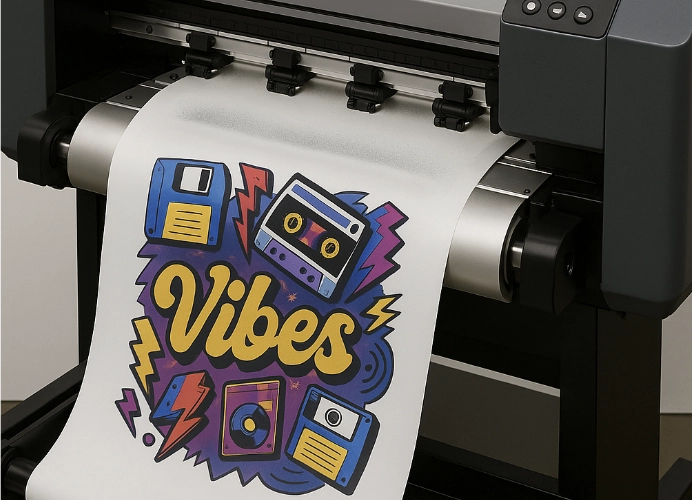
In recent years, Direct-to-Film (DTF) or printing onto film and then heat pressing onto fabric has become the heart of small to medium-sized screen printing businesses. With its flexible capabilities, suitability for various fabrics, and support for high-detail printing, DTF technology has not stagnated. There have been several new innovations that screen printing shops should study and consider adopting to maintain a competitive edge and create a modern, technologically advanced image for customers.
This article will discuss the main innovations, including new inks and materials, printers and automation, workflow and software, support for various materials, and environmental approaches.
1. New DTF Inks, Materials, and Films
One of the key innovations in DTF is the development of “consumables” such as high-quality inks, films, and adhesives with diverse properties.
The secret to the best DTF printing lies in the “materials” used. Leading manufacturers are developing materials to achieve the highest efficiency to meet the demands of high-quality work today:
1.1 High-Quality Printing Inks
Producers of DTF inks have developed “special ink formulas” that provide brighter colors, better resistance to washing and wear, and do not fade or crack. New ink formulas have a higher concentration of pigment, making colors more vivid and durable even after repeated washing without fading or cracking.
There are also eco-friendly or water-based pigment inks that reduce VOCs and cater to environmentally conscious consumers.
Moreover, there are glow-in-the-dark inks. Adding glow-in-the-dark or semi-reflective (Neon/Fluorescent) inks to the DTF system makes screen printing more eye-catching, suitable for fashion and sports apparel.
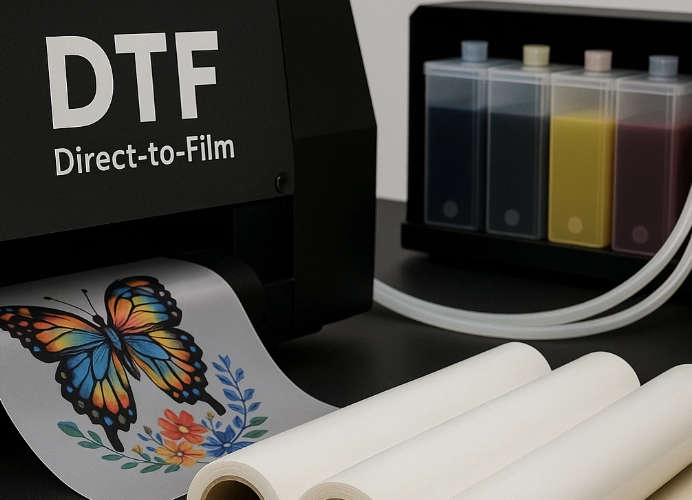
1.2 New PET Films and Adhesive Powders
DTF films are crucial as they act as a medium between the design and fabric. New materials are more compatible with various substrates and have improved properties such as higher transparency, better coating quality, and easier sheet removal.
Adhesives have also evolved, such as powderless DTF that reduces dust and provides a softer feel.
Choosing high-quality films and adhesives will help reduce issues like peeling, lifting, or color distortion and enable you to offer higher quality products.
2. Next-Generation DTF Printers & Automation Systems
In addition to consumables, “printers” are another rapidly evolving aspect, particularly in terms of speed, accuracy, and process control.
2.1 Higher Speed and Efficiency
The article confirms that DTF technology is entering an era where printers can print faster and are designed to better suit high-volume work. For example, single-pass or roll-to-roll machines are ideal for mass production.
For screen printing shops, choosing a high-efficiency machine can reduce production time, increase the ability to handle large orders, and provide faster service, which may differentiate them in the market.
2.2 Automation and AI for Quality Control
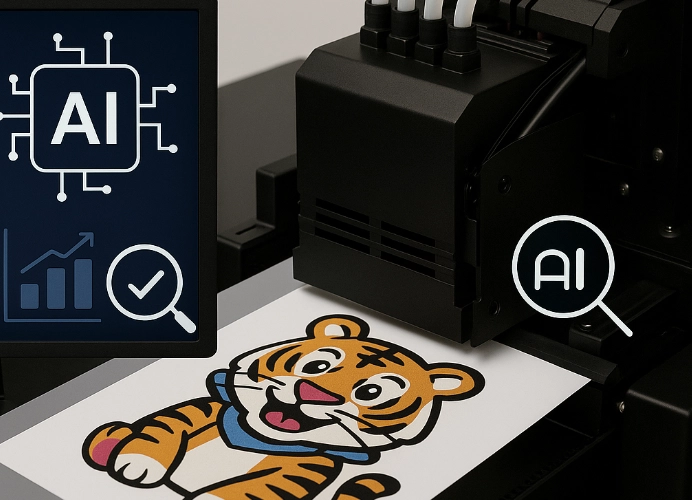
Another interesting innovation is the use of AI or machine learning in DTF systems to help “predict problems,” “automatically adjust settings,” “check quality,” and “reduce errors.”
Automation systems, such as automatic powdering, curing, and sheet stripping, reduce labor and minimize risks.
Installing machines with automation systems or AI features can help you manage work more efficiently and increase customer trust.
3. Increased Material Compatibility (Substrate Expansion)
One of the advantages of DTF is its ability to print on various fabrics, but new innovations are expanding this range.
3.1 More Diverse Materials
UV DTF: Revolutionizing Hard Surface Printing
UV DTF (Ultra Violet Direct to Film) is an advancement from standard DTF, where UV ink is printed onto a special film, then coated with adhesive and laminating film to create “transfer stickers” that can adhere to almost any hard surface.
Adheres to Any Surface: Glass, water bottles, plastic, metal, wood, ceramics (not fabric)
Extra Durable: The printed design is slightly raised and durable against scratches and cleaning (even dishwasher-safe)
No Minimums/Limited Shapes: No need for white die-cutting, allowing for easy printing of small logos or intricate details
Premium Transformation: Ideal for creating memorabilia, premium products, phone cases, or logo stickers for various equipment.
3.2 Larger Print Sizes
New DTF machines can accommodate larger films and printing areas, allowing stores to produce wide-format or large-scale designs. The article mentions that the machines can print roll-to-roll and up to 63-inch sizes.
With machines that support larger sizes, businesses can take on larger jobs such as back-printed shirts, jackets, blankets, and throws, thereby increasing the value of their work.
High-Speed Printers: The printhead and film feed systems have been developed to print much faster without compromising on resolution (often up to 1200 dpi or higher).
Automatic Maintenance Systems: Automatic white ink circulation systems and improved printhead cleaning systems help reduce clogged printhead issues, a common problem with older DTF machines.
Integrated Adhesive Coating and Baking Systems: Continuous machines that work from printing to adhesive coating, baking, and film winding to increase production capacity for large orders.
4. Environmental Impact and Sustainability
In an era where consumers are increasingly concerned about the environment, DTF technology cannot remain static. It must evolve to become more “environmentally friendly.”
4.1 Environmentally Friendly Ink and Materials
Several brands are now using water-based ink, pigment ink, biodegradable film, or recyclable film, and adhesives that reduce harmful chemicals.
Choosing certified materials such as OEKO-TEX® (our store imports OEKO-TEX® certified products), GOTS, or communicating that “no PVC or phthalate is used” can attract environmentally conscious customers.
4.2 Energy Efficiency and Waste Reduction
Innovations focus on reducing energy consumption in printers, minimizing ink waste, reducing film waste, or developing more efficient workflows.
Having a system that reduces energy and waste costs (such as excess dry powder, rejected poor quality work) can help create an image of a store that cares about both quality and the environment.
5. Business Models and Services Driven by New DTF Innovations
Innovations in DTF are not limited to machines or materials but also include new business models and services that are emerging.
5.1 On-Demand Printing
With the flexibility of DTF, stores can offer print-on-demand or custom order services without maintaining large stock inventories.
5.2 Value-Added and Special Finishing Services
Innovations such as 3D texture, puff effect, glow-in-the-dark, and UV effects on DTF are gaining popularity.
These can be offered as special options to customers, thereby increasing the value of the work and setting the store apart from others.
5.3 Connecting with E-commerce Systems and Automated Workflow
Shops that integrate their online systems with DTF production gain an advantage, such as those connected to Shopify, Etsy, automated order printing systems, and real-time order tracking.
With clear online channels and a robust backend system, they can effectively meet the needs of digital-era customers.
6. Practices That Screen Printing Shops Should Implement
To not miss out on DTF innovations and to compete effectively, here are steps that shops should take:
Study new materials and machinery: Check if your printers, inks, and films are standard or support innovations such as powderless, auto-material sensing, and large format.
Conduct pilot tests before major investments: Order samples of new inks, films, or machines, test actual printing with various materials and fabrics, and compare results.
Adapt your workflow to support innovations: Use software to manage online orders, set up automated production processes, and establish SOPs for new machines.
Train staff and set quality control standards: Check color, clarity, adhesion, and wash tests to ensure quality and consistency.
Stay informed about trends and new market channels: Follow DTF expos, material changes, and new product samples to keep your shop up-to-date.
Evaluate costs and returns: While innovations are beneficial, consider additional costs such as premium inks/films, large machines, special finishing, and analyze how they add value to your work.
Summary
Innovations in the DTF industry are rapidly evolving in terms of ink, materials, films, faster and more automated machines, support for a variety of materials, and diverse business approaches. These are not just about technology but have clear business implications for screen printing shops.
Choosing high-quality printing materials, new-generation machines, and online systems linked to production can help your shop stay ahead of competitors and attract customers who value quality and technological leadership.
Ready to Print Custom DTF with Screen168 Bangkok?
Single pieces to bulk wholesale. Free artwork file check and instant online pricing 24/7.
🚀 View Sizes, Prices & Order Online→